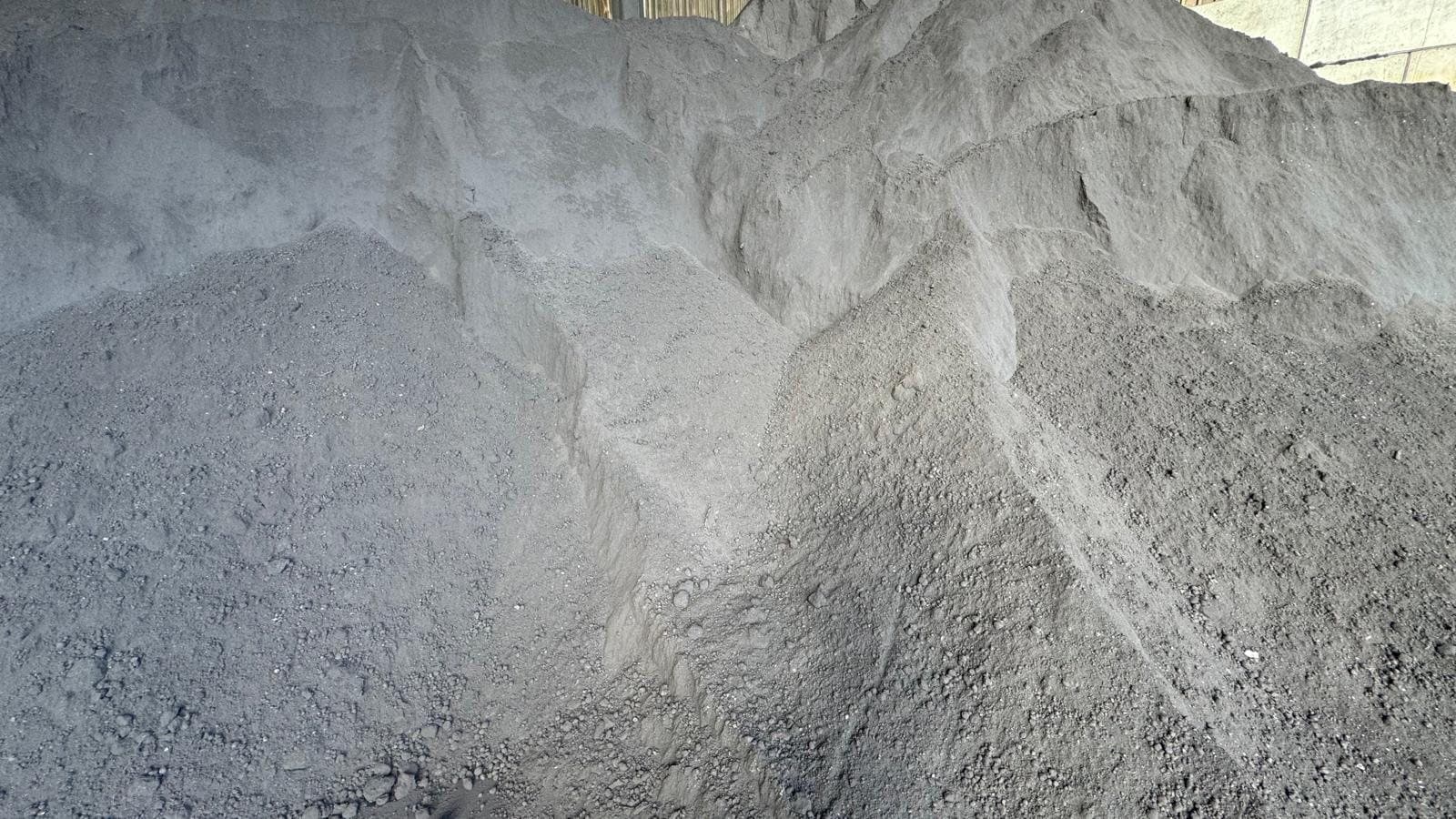
Product Data
Material type
Iron oxide-rich secondary raw material
Appearance
Solid, bulk material
Particle size
< 20 mm
EWC
19 12 02
Analysis and Quality
The available measurements report iron oxide as Fe2O3. Concrete values are reviewed batch by batch; the figures are not a general guarantee for every delivery.
Fe2O3 (analysis value)
approx. 83-93% in available measurements
Moisture
reviewed batch by batch
Documents
product information and analysis available
What Is Mill Scale?
Formation
During reheating, hot rolling and hot forming, the steel surface oxidises. The resulting layer is removed during descaling and recovered as mill scale.
Composition
Mill scale consists predominantly of iron oxides – typically wüstite (FeO), magnetite (Fe3O4) and hematite (Fe2O3). This makes it a versatile iron oxide carrier for suitable industrial processes.
Metallurgical significance
The iron is present in oxide-bound form. In suitable reducing processes, the iron oxides can be converted back into metallic iron and used as a secondary iron source.
Potential Foundry and Industrial Applications
Depending on the process and material specification, different application routes may be considered:
Furnace and charge concepts
In suitable reducing processes, conditioned or briquetted mill scale may be used as an additional iron oxide carrier. Furnace type, reducing agent, slag practice and analysis are decisive.
Clinker production
In the cement industry, mill scale may be used as an iron corrective in the raw meal. Dosage, raw meal chemistry and plant-specific acceptance limits, particularly for chromium and other heavy metals, are decisive.
Suitability and dosage must be assessed and approved by the user for each batch and process.
Product Information
The product information sheet includes description, product data, analysis excerpt, handling information and practical safety notes.
Download PDFFurther batch data or safety data sheet can be provided if required.
produktinformationsblatt-walzzunder.pdf